UPDATE: CVSA Brake Safety Week 2026 is here. [Click here for the latest 2026 dates, focus areas, and preparation tips.]
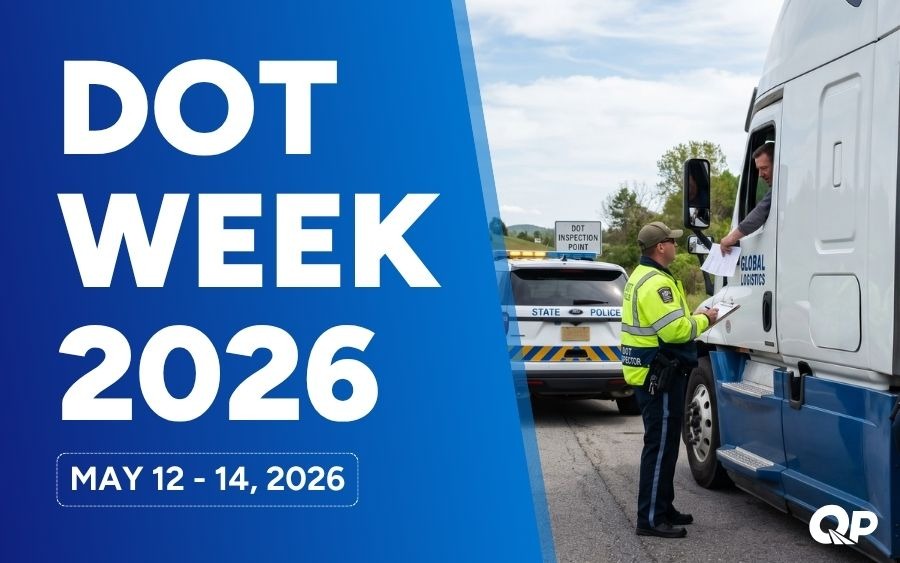
The Commercial Vehicle Safety Alliance (CVSA) has scheduled the 2026 International Roadcheck – aka DOT Week or DOT Blitz Week – for May 12–14, 2026. During this 72-hour period, inspectors across the U.S., Canada, and Mexico will conduct an average of 15 inspections per minute.
For trucking companies and owner-operators, this “DOT Blitz” is more than a safety check—it’s a major operational hurdle that can lead to out-of-service (OOS) orders, costly fines, and freight delays.
DOT Week 2026 Overview
- Dates: Tuesday, May 12 – Thursday, May 14, 2026.
- Scale: Continent-wide (USA, Canada, Mexico).
- Primary Inspection: North American Standard Level I Inspection (37-step procedure).
- 2026 Focus Areas: ELD Tampering (Driver) and Cargo Securement (Vehicle).
What Is the CVSA International Roadcheck?
The CVSA International Roadcheck, also known as DOT Blitz Week, is the largest targeted enforcement program on commercial motor vehicles in the world.
Over a 72-hour period, inspectors conduct tens of thousands of inspections at:
- Weigh stations
- Inspection sites
- Roadside checkpoints
The goal is simple: ensure compliance with safety regulations and remove unsafe drivers and vehicles from the road.
2026 Focus Areas: What Inspectors Are Targeting
The focus of the International Roadcheck changes each year, and the focus for the 2026 event will be on two areas:
1. Driver Focus: ELD Tampering & Falsification
While Hours-of-Service (HOS) is always a priority, the 2026 focus is specifically on Electronic Logging Device (ELD) manipulation. Inspectors are trained to look for ‘ghost’ logs and hardware bypasses according to official FMCSA ELD guidelines.
What they will check:
- Data Integrity: Identifying driving time while the device is “disconnected” or “unidentified.”
- Unassigned Driving: Checking for miles moved without a logged driver.
- Supporting Documents: Matching fuel receipts, toll records, and GPS pings against your ELD entries.
- Device Proficiency: Can the driver successfully transfer the ELD data file to the inspector?
The Cost of Non-Compliance: False records of duty status (RODS) can result in civil penalties of up to $1,584 per day, with serious violations reaching $15,846.
2. Vehicle Focus: Cargo Securement
In 2025 alone, over 34,000 violations were recorded for unsecured vehicle components and leaking/falling cargo. This year, the CVSA is enforcing strict compliance with FMCSA Cargo Securement Rules (49 CFR Part 393) to prevent roadway hazards.
What they will check:
- Tie-down Integrity: Looking for frayed straps, rusted chains, or cracked anchor points.
- Blocking & Bracing: Ensuring the load cannot shift, which affects vehicle maneuverability.
- Equipment Condition: Checking that tailboards, doors, and end gates are securely latched.
- Dunnage & Tools: Verifying that spare equipment (chains, tarps, etc.) is properly fastened to the vehicle.

DOT Week Checklist for Drivers and Fleets
To minimize the risk of a costly Out-of-Service (OOS) order, use the following pre-trip diligence checklist to ensure your fleet is prepared for the 2026 inspection criteria.
Audit ELD Records
- [ ] Clear all “Unassigned Driving” periods in your ELD system.
- [ ] Ensure all manual edits have clear, regulatory-compliant annotations.
- [ ] Verify the ELD is properly mounted and visible to the driver.
Inspect Securement Hardware
- [ ] Replace any straps with visible cuts or “burn” marks.
- [ ] Check that the number of tie-downs meets the aggregate working load limit (WLL) for your cargo weight.
- [ ] Inspect friction mats and edge protectors for excessive wear.
Visibility & Mechanical Check
- [ ] Lighting: Test all blinkers, brake lights, and clearance lamps.
- [ ] Tires: Ensure no audible leaks and that tread depth is at least 4/32” on steer tires.
- [ ] Tractor Protection: Test the tractor protection valve and trailer supply valve to ensure they pop at the correct PSI (usually 20-45 PSI).
What Happens During a DOT Inspection?
A Level I inspection includes a 37-step process reviewing driver credentials, ELD logs, and key vehicle components like brakes, tires, lights, and cargo securement. If you are pulled over for a Level I Inspection, the process is systematic:
1. Credential Check: License, Medical Examiner’s Certificate, and Skill Performance Evaluation (if applicable).
2. Drug & Alcohol Clearinghouse: Real-time query to ensure the driver is not in “prohibited” status.
3. The Walk-Around: Checking the fuel system, exhaust, frame, steering, and suspension.
4. The Outcome:
- Pass: If no critical violations are found, you may receive a CVSA decal, which generally exempts you from further inspections for three months.
- Fail (Violations): You may receive a citation but be allowed to continue.
- Out-of-Service (OOS): If a “Critical Vehicle Inspection Item” is found, the truck or driver is sidelined until the issue is fixed.
FAQ: 2026 DOT Blitz Week
Q: What is DOT Blitz Week?
A: DOT Blitz Week, also known as the CVSA International Roadcheck, is the largest targeted enforcement program on commercial motor vehicles in the world.
Over a 72-hour period, inspectors conduct tens of thousands of inspections at:
- Weigh stations
- Inspection sites
- Roadside checkpoints
The goal is simple: ensure compliance with safety regulations and remove unsafe drivers and vehicles from the road.
Q: When is DOT Blitz Week 2026?
A: DOT Blitz Week 2026 runs from May 12 through May 14, 2026.
Q: What are the focus areas for 2026?
A: Driver Focus: ELD tampering and falsified logs. Vehicle Focus: Cargo securement.
Q: What happens during a DOT inspection?
A: A Level I inspection includes a 37-step process reviewing driver credentials, ELD logs, and key vehicle components like brakes, tires, lights, and cargo securement.
Q: Can I avoid inspection by parking my truck?
A: While some drivers choose to stay off the road, operating safely and passing an inspection earns you a CVSA decal, which can actually save you time over the following 90 days.
Q: What is the most common driver violation?
A: Historically, Hours-of-Service (HOS) violations account for over 30% of driver out-of-service orders.
Q: Does Roadcheck affect Canada and Mexico?
A: Yes, this is a North American event. Inspectors in all three countries will be following the same Level I criteria.