Cash flow is one of the biggest challenges facing modern trucking companies. While immediate operating expenses like fuel, payroll, insurance, and truck maintenance must be paid on demand, freight brokers and shippers often take 30, 45, or even 60 days to clear invoices.
Freight factoring solves this structural cash flow problem by allowing trucking companies to convert unpaid freight invoices into immediate working capital.
In this comprehensive guide, we’ll explain exactly what freight factoring is, how it works, how much it costs, and why thousands of carriers rely on it to keep their fleets moving, eliminate payment gaps, and successfully scale their logistics businesses.
What Is Freight Factoring?
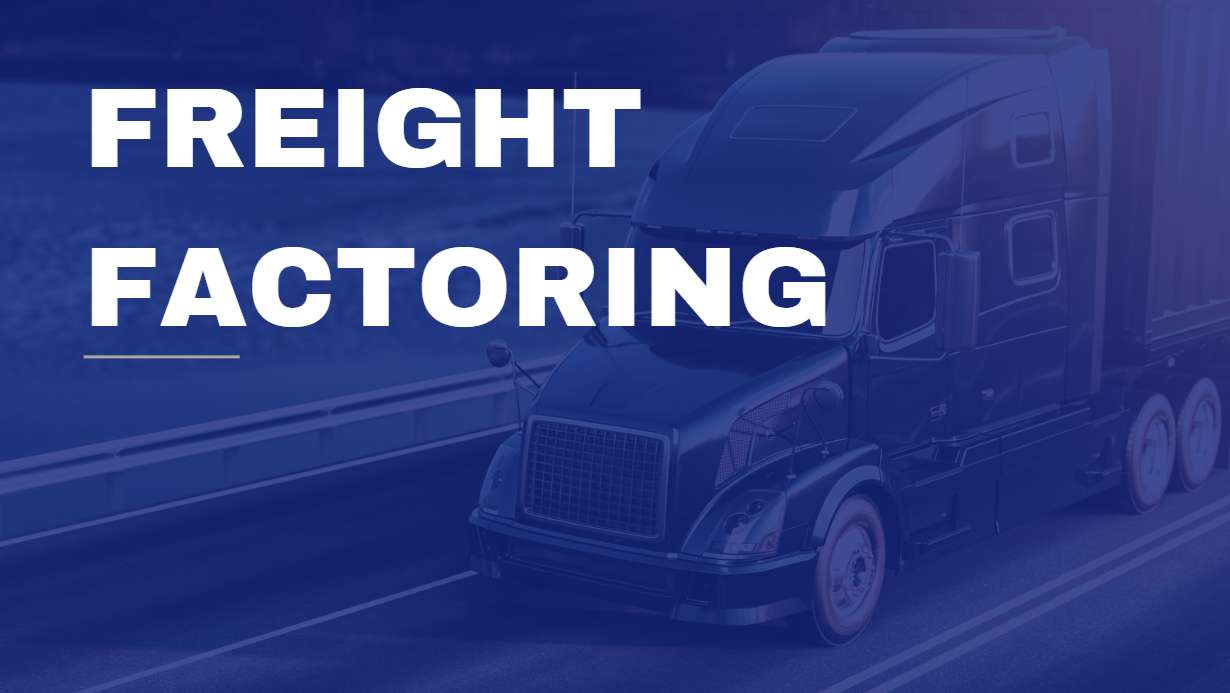
Freight factoring, also known as trucking factoring or freight invoice factoring, is a financing solution that allows trucking companies to receive immediate payment for delivered loads instead of waiting for brokers or shippers to pay.
A freight factoring company purchases your outstanding freight invoices and advances most of the invoice value upfront. Once the customer pays the invoice, the factoring company sends the remaining balance, less its factoring fee.
This provides trucking companies with fast access to cash without taking on traditional debt.
Example of Freight Factoring
Let’s say your trucking company delivers a load and issues a $5,000 freight invoice with net-30 payment terms.
Without freight factoring:
- Deliver load
- Submit invoice
- Wait 30 days for payment
- Pay expenses out of pocket
With freight factoring:
- Deliver load
- Submit invoice to factoring company
- Receive funding, often the same day
- Continue operating without waiting 30 days
Instead of waiting weeks to get paid, your company receives cash immediately.
How Does Freight Factoring Work?
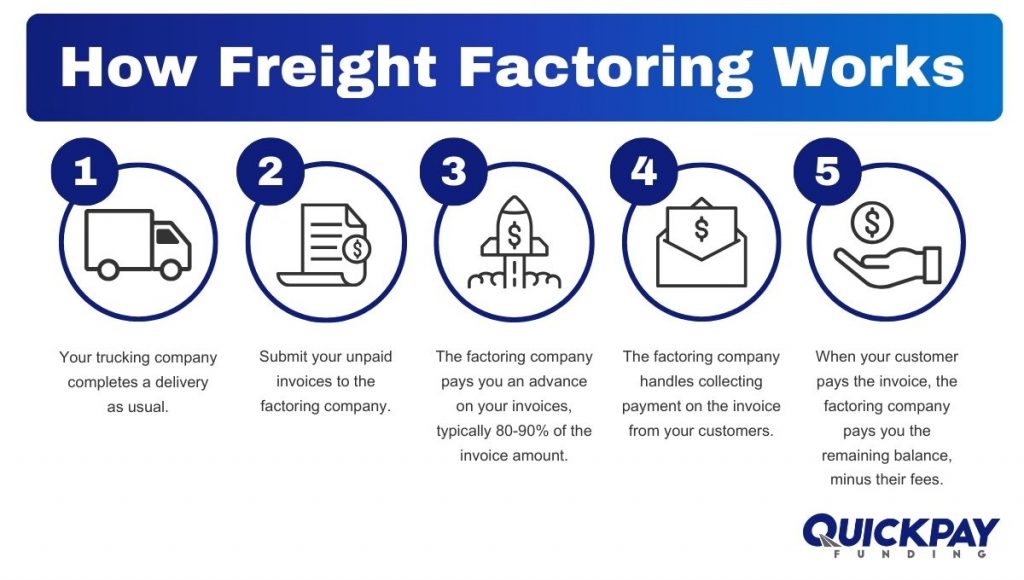
The freight factoring process is simple and can be completed in just a few steps.
Step 1: Deliver the Load
Your trucking company transports freight and obtains the required paperwork, such as a signed bill of lading or proof of delivery.
Step 2: Submit the Invoice
You submit the invoice and supporting documents to a freight factoring company like Quickpay Funding.
Step 3: Receive an Advance
The factoring company verifies the invoice and advances a large percentage of its value, typically between 80% and 98%.
Step 4: Customer Pays the Invoice
The broker or shipper pays the factoring company according to the invoice terms.
Step 5: Receive the Remaining Balance
After payment is received, the factoring company deducts its fee and remits any remaining funds to your company.
Why Trucking Companies Use Freight Factoring
Trucking companies have to pay for fuel, payroll, insurance, maintenance, and other expenses long before many brokers and shippers pay their invoices. Freight factoring helps bridge that gap by converting unpaid invoices into cash within 24 hours.
Faster Cash Flow
Instead of waiting weeks on standard broker payment terms, trucking companies can receive funding shortly after delivery.
No New Debt
Factoring is an asset sale (unpaid invoice), not a loan. Trucking companies sell their accounts receivable rather than borrowing money, which means the transaction adds no new liabilities, interest payments, or debt to the company’s financial records.
Support Business Growth
With faster access to cash, carriers can take on additional loads, add trucks, hire drivers, and increase freight volume without having to wait for existing invoices to be paid.
Reduce Administrative Work
Many freight factoring companies, such as Quickpay Funding, handle invoice processing, payment tracking, collections, customer credit checks, and other accounts receivable tasks. This can reduce the amount of time trucking companies spend managing unpaid invoices.
Easier Approval Than Traditional Loans
Factoring companies primarily look at the creditworthiness of the brokers and shippers that owe the invoices. This can make freight factoring easier to qualify for than traditional bank financing, particularly for newer trucking companies and growing fleets.
What Does Freight Factoring Cost?
Freight factoring fees vary based on several factors, including:
- Monthly factoring volume
- Customer credit quality
- Average invoice size
- Payment terms
- Factoring structure
Most freight factoring companies charge a small percentage (typically 1% to 5%) of the overall invoice amount as their fee.
While cost is important, carriers should also consider:
- Funding speed
- Customer service
- Fuel advances
- Credit monitoring
- Contract requirements
- Hidden fees
The cheapest factoring company isn’t always the best value.
Recourse vs. Non-Recourse Freight Factoring
When researching freight factoring companies, you’ll likely come across two types of factoring: recourse factoring and non-recourse factoring.
Understanding the difference is important because many trucking companies assume non-recourse factoring protects them from all unpaid invoices. In reality, the coverage is often much more limited.
What Is Recourse Freight Factoring?
With recourse factoring, the trucking company ultimately remains responsible if a customer fails to pay an invoice.
Recourse factoring is the most common type of freight factoring because it typically offers:
- Lower factoring fees
- Higher advance rates
- Simpler agreements
- Greater flexibility
What Is Non-Recourse Freight Factoring?
With non-recourse factoring, the factoring company assumes certain credit-related risks if an approved customer becomes insolvent or declares bankruptcy.
While non-recourse factoring can provide additional protection, it’s important to understand exactly what situations are covered. In many agreements, non-recourse protection applies only to customer insolvency or bankruptcy.
Issues such as billing disputes, cargo claims, documentation errors, fraud, short payments, or other non-credit-related disputes may still remain the responsibility of the trucking company.
Recourse vs. Non-Recourse Factoring
| Recourse Factoring | Non-Recourse Factoring |
|---|---|
| Lower factoring fees | Higher factoring fees |
| Most common in trucking | Less common |
| Carrier assumes customer credit risk | Limited protection against approved customer insolvency |
| Flexible and cost-effective | Additional coverage provisions |
For many trucking companies, the most important consideration isn’t simply whether a factoring program is recourse or non-recourse. It’s understanding exactly what risks are covered, what costs are involved, and which option best fits the needs of the business.
Choosing a Freight Factoring Company
Not all freight factoring companies offer the same funding speed, fees, customer service, or additional services. When comparing providers, consider factors such as advance rates, contract terms, fuel advances, credit checks, and funding availability.
For a detailed breakdown of what to look for in a factoring provider, read our guide on How to Find the Best Freight Factoring Company.
Why Trucking Companies Choose Quickpay Funding
Quickpay Funding helps trucking companies improve cash flow with fast, flexible freight factoring services designed specifically for the transportation industry.
Benefits include:
- Same-day funding
- 24/7 funding through Real-Time Payments (RTP)
- Fuel advances available 24/7
- Free and unlimited credit checks
- Customer support available 24/7
- Carrier packet management at no additional cost
- No hidden fees
Whether you’re an owner-operator, growing fleet, or freight broker, Quickpay Funding provides the working capital needed to keep your business moving.
Get Started with Freight Factoring
Freight factoring allows trucking companies to convert unpaid freight invoices into immediate cash, helping them cover expenses, stabilize cash flow, and grow their operations.
If you’re looking for a freight factoring company that offers same-day funding, 24/7 Real-Time Payments, fuel advances, and dedicated customer support, Quickpay Funding can help.
Learn more about our Freight Factoring Services or contact our team to discuss your trucking company’s financing needs.